
How to Track Leads and Customer Interactions with Odoo CRM
Managing leads and customer conversations becomes challenging when information is spread across spreadsheets, emails, phone calls, and different business tools. Sales teams may miss follow-ups, lose track of customer requirements, or struggle to identify which prospects are most likely to convert.
Odoo CRM helps businesses bring lead information, sales activities, opportunities, and customer interactions into one organized system. With a clear view of each prospect and the history of communication, sales teams can follow up at the right time, prioritize promising opportunities, and deliver a more consistent customer experience.
In this blog, we’ll explore how Odoo CRM helps businesses track leads and customer interactions throughout the sales process.
What Is Lead Tracking in Odoo CRM?
Lead tracking is the process of recording and monitoring potential customers from their first interaction with a business through qualification and conversion. It helps sales teams understand where each prospect comes from, what they need, and what action should happen next.
Odoo CRM provides a central place to manage this information. Depending on how the CRM is configured, teams can record details such as:
- Lead name and contact information
- Company and job title
- Lead source, such as a website inquiry, referral, or campaign
- Products or services the prospect is interested in
- Assigned salesperson
- Next follow-up activity
- Current status and qualification details
Having these details in one place reduces the need to search through separate records and helps sales representatives prepare for every conversation.
How to Track Leads in Odoo CRM
1. Capture Leads from Different Sources
Leads can come from website forms, email inquiries, phone calls, events, referrals, and marketing campaigns. When these prospects are recorded in separate systems, it becomes harder to maintain accurate information and respond promptly.
Odoo CRM can help consolidate lead information. Depending on the apps and integrations enabled, businesses can connect website inquiries, email workflows, and other lead-generation channels to their CRM process. Sales representatives can also enter leads manually when they receive inquiries offline.
Recording the source of each lead helps businesses understand which channels generate potential customers and where sales teams should focus their attention.
2. Organize and Qualify Leads
Not every inquiry is ready to become a sales opportunity. Some prospects may be researching options, while others may have a clear requirement and an immediate purchasing timeline.
Sales teams can use Odoo CRM to record qualification details and organize leads based on their needs, level of interest, budget, business fit, or expected purchase timeline. Teams can also use tags, filters, and custom fields where appropriate to group and prioritize prospects.
Once a lead is qualified, it can be converted into an opportunity according to the company’s sales process. This gives the sales team a clearer way to distinguish early inquiries from prospects with a more developed buying intent.
3. Track Opportunities Through the Sales Pipeline
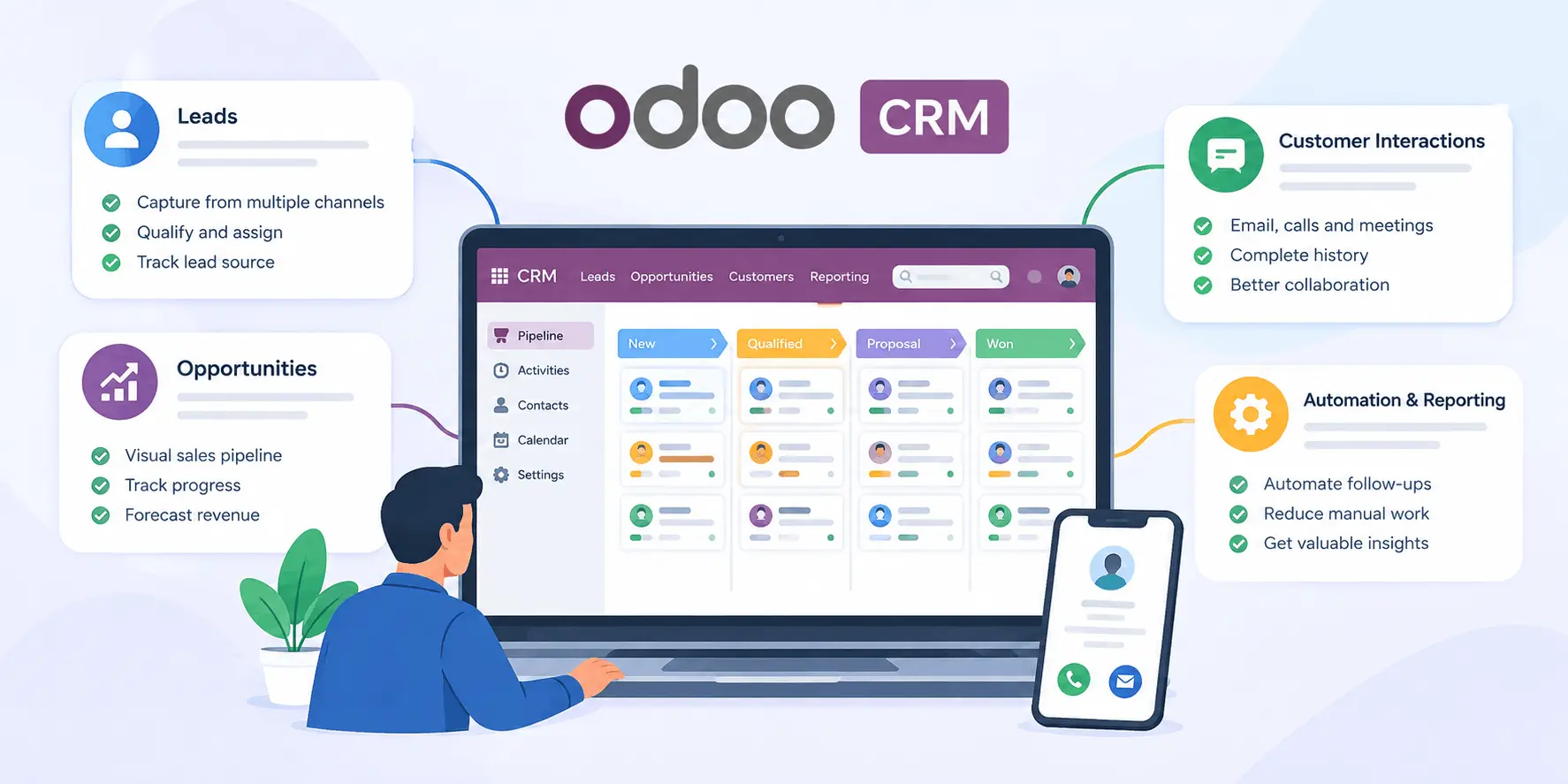
An opportunity represents a potential sale that the team is actively pursuing. Odoo CRM uses a visual pipeline to help salespeople monitor opportunities as they progress through stages such as qualification, proposal, negotiation, and won or lost.
The stages can be adapted to match the organization’s sales process. Each opportunity can contain relevant details, including the expected revenue, assigned salesperson, planned activities, and information about the customer’s requirements.
A visual pipeline helps managers identify opportunities that have stalled, review upcoming sales activities, and understand how deals are progressing. Instead of relying only on verbal updates, the team can refer to a shared record of the current sales position.
4. Schedule Follow-Ups and Sales Activities
Consistent follow-up is essential for converting leads into customers. However, when salespeople rely on memory or scattered reminders, important conversations can be delayed or forgotten.
Odoo CRM allows users to schedule activities such as calls, meetings, emails, and follow-up tasks against leads or opportunities. Activities can have deadlines and assigned users, helping representatives plan their next steps.
For example, after a product demonstration, a salesperson can schedule a follow-up call for the next business day. The activity remains associated with the relevant record, making it easier to see what needs attention.
Automated activities and reminders may also be configured for selected sales processes, depending on the team’s workflow and Odoo setup.
How Odoo CRM Tracks Customer Interactions
Lead details explain who a prospect is, while interaction history helps the team understand what has happened during the relationship. Keeping these records together is particularly useful when multiple employees work with the same customer.
1. Maintain a History of Customer Communication
Odoo CRM provides a communication log through the chatter area on relevant records. Depending on the interaction and system configuration, users can review messages, notes, scheduled activities, and other updates associated with a lead or opportunity.
This history helps sales representatives answer important questions before contacting a prospect:
- What did the customer ask during the last conversation?
- Was a quotation or proposal discussed?
- Which information has already been shared?
- What follow-up was promised?
- Who last communicated with the customer?
With this context available, salespeople can avoid asking customers to repeat information and provide more informed responses.
2. Connect Emails and Meetings to the Right Record
Email is often central to the sales process, but conversations become difficult to manage when they remain in individual inboxes. Odoo can support email communication linked to CRM records, subject to email configuration and the workflow being used.
When emails are associated with the correct lead or opportunity, team members can review relevant correspondence without depending entirely on the original salesperson. Meetings and calls can also be recorded or scheduled as activities, giving the team a more complete view of customer engagement.
Businesses should establish clear practices for logging interactions and linking communication to the appropriate record. This helps keep the history useful and reduces gaps in customer information.
3. Record Notes, Requirements, and Customer Preferences
Not every important interaction happens through email. A phone call may reveal a customer’s budget, a meeting may uncover a technical requirement, or a product discussion may establish a preferred delivery timeline.
Sales representatives can add internal notes and update the relevant CRM fields to preserve these details. This makes customer information easier for authorized colleagues to access when they need to support the account.
Useful records should be concise, relevant, and factual. Teams should avoid storing unnecessary sensitive information and follow their organization’s data-access and retention policies.
4. Improve Team Handoffs and Collaboration
When a lead moves from one salesperson to another, missing context can delay the next step and create a poor customer experience. A shared CRM record helps team members review previous discussions, current requirements, outstanding activities, and the status of the opportunity.
Sales managers can also use the information to review workload, coordinate responsibilities, and identify records that need attention.
Access permissions and internal processes should be configured carefully so employees can view the information required for their roles without exposing records unnecessarily.
Using Odoo CRM Automation to Reduce Manual Work
Automation can make lead tracking more consistent by reducing repetitive administrative tasks. Odoo CRM supports configurable sales workflows, and additional automation may be available through related Odoo apps or custom development.
Examples include:
- Lead assignment: Route incoming leads to the appropriate salesperson based on defined rules.
- Follow-up reminders: Schedule activities so representatives know when to contact a prospect.
- Activity planning: Create repeatable next steps for common stages of the sales process.
- Lead nurturing: Use suitable marketing tools and integrations to maintain communication with prospects who are not yet ready to buy.
- Record updates: Configure supported rules or custom workflows to update selected fields when specific conditions are met.
Automation should reflect the actual sales process rather than add unnecessary steps. Before implementing it, businesses should define ownership rules, qualification criteria, follow-up timelines, and the events that should trigger an action.
How Odoo CRM Reports Help Monitor Sales Activity
Tracking individual leads is important, but managers also need to understand overall sales performance. Odoo CRM reporting tools can help teams analyze opportunities and sales activity using the data recorded in the system.
Depending on the Odoo version, configuration, and available data, businesses can review metrics such as:
- Number of leads received over a period
- Opportunities by sales stage
- Lead sources and their contribution to the pipeline
- Activities scheduled or completed
- Expected revenue from open opportunities
- Won and lost opportunities
- Conversion rates between defined stages
These reports help reveal patterns. For example, a large number of leads with few qualified opportunities may indicate a targeting or qualification issue. Opportunities that remain in one stage for too long may suggest that follow-up or decision-making is delayed.
Reports are only as reliable as the data entered into the CRM. Teams should use consistent definitions for lead status, opportunity stages, lost reasons, and activity completion.
Best Practices for Accurate Lead and Interaction Tracking
Odoo CRM works best when the team follows a consistent process. The following practices can improve data quality and make customer records more useful.
Define clear sales stages. Give each pipeline stage a clear meaning so every salesperson uses it consistently.
Assign ownership for every lead. Make sure incoming inquiries have a responsible person and a clear next action.
Log important interactions promptly. Record useful call outcomes, meetings, customer requirements, and agreed follow-ups while the details are still fresh.
Keep records current. Update opportunity stages, expected closing dates, contact details, and next activities as circumstances change.
Use automation selectively. Automate repeatable tasks where it improves consistency, but keep the workflow simple enough for the team to maintain.
Review the pipeline regularly. Sales managers should look for overdue activities, inactive opportunities, missing information, and deals that need additional support.
Train the team. Ensure employees know how to create records, schedule activities, update stages, and record communications correctly.
How DX8 Can Help You Configure Odoo CRM
Every business has its own sales process, customer journey, and reporting requirements. A standard CRM setup may be enough for some teams, while others may need tailored stages, lead assignment rules, integrations, automated activities, or custom reports.
DX8 helps businesses assess their requirements and configure Odoo solutions around their workflows. This can include setting up CRM pipelines, improving lead management, connecting relevant business tools, and tailoring functionality where standard features do not meet operational needs.
A well-planned implementation helps the sales team work from consistent customer records, understand the next step for each opportunity, and make better use of the information collected throughout the sales process.
Conclusion
Tracking leads and customer interactions is about more than storing contact details. Businesses need to know where prospects come from, how opportunities are progressing, what has been discussed, and which action should happen next.
Odoo CRM brings lead records, sales pipelines, scheduled activities, and communication history into a connected workspace. With clear processes, accurate data, and appropriate automation, sales teams can reduce missed follow-ups, improve collaboration, and gain better visibility into their pipeline.
If your business wants to organize its sales process and make customer interactions easier to manage, DX8 can help you explore an Odoo CRM setup that fits your requirements.
