

Swati Rawat

Swati Rawat is a writer and researcher with a strong interest in digital transformation, emerging technologies, and the evolving intersection of business and innovation. At DX8, she focuses on translating complex ideas into clear, actionable insights, helping readers understand how technology shapes modern organizations and decision-making. With a detail-oriented approach and a passion for continuous learning, Swati contributes thoughtful, well-researched content designed to inform, engage, and empower a global audience.

Odoo vs Zoho

Odoo vs Zoho: A Realistic Comparison for Indian Businesses

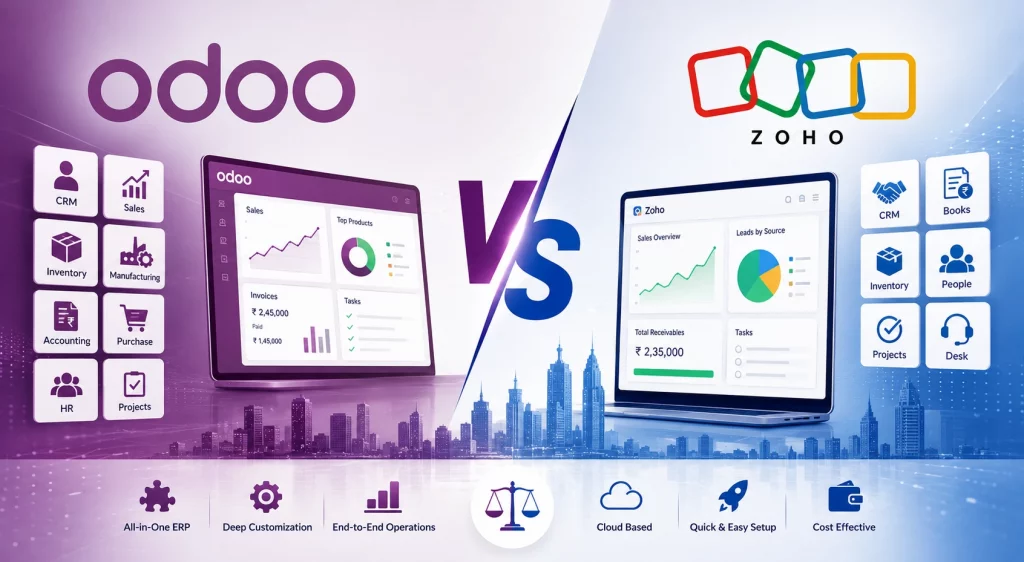
Odoo vs Zoho: A Realistic Comparison for Indian Businesses admin May 18, 2026 Indian businesses today are no longer choosing software just for accounting or CRM. They are choosing an operational backbone that can handle GST, inventory, payroll, sales, customer support, automation, eCommerce, and scalability. Two names dominate this conversation: Odoo and Zoho. Both platforms are powerful. Both are widely used in India. But they solve business problems very differently. This comparison is not about “which is better globally.”It is about which platform makes more sense for Indian SMEs, startups, manufacturers, traders, distributors, and service companies. The Core Difference Between Odoo and Zoho Before comparing features, it’s important to understand the philosophy behind both systems. Odoo: ERP-First Approach Odoo is fundamentally an ERP platform. It is designed to connect operations across departments: Sales CRM Inventory Manufacturing Accounting HR Purchase Projects eCommerce Everything runs on a unified database and workflow system. This becomes valuable when a business grows beyond simple bookkeeping or CRM needs. Zoho: SaaS Ecosystem Approach Zoho started as a cloud productivity and CRM company. Instead of one deeply unified ERP, Zoho offers a large ecosystem of apps, such as: Zoho CRM Zoho Books Zoho Inventory Zoho People Zoho Desk Zoho Projects For many Indian SMEs, this creates a fast, affordable, cloud-first setup. Odoo vs Zoho: Feature-by-Feature Comparison Feature Odoo Zoho Best For Operationally complex businesses Fast-moving SMEs & startups Deployment Cloud, On-Premise, Hybrid Primarily Cloud SaaS Customization Extremely high Moderate Ease of Setup Medium to complex Easy Manufacturing Support Strong native MRP Limited GST Compliance Strong with localization Excellent out of the box CRM Integrated ERP CRM One of Zoho’s strongest products Inventory Management Advanced Good for light-medium operations Implementation Cost Higher Lower Scalability Very high Good for SMB growth Technical Dependency Often needs implementation partner Lower dependency User Experience Functional and modular Cleaner for non-technical teams Where Zoho Wins for Indian Businesses 1. Faster Deployment Zoho is usually much quicker to implement. Many Indian startups can start using: Zoho Books Zoho CRM Zoho Inventory within days instead of months. That matters when: teams are small, processes are evolving, and budgets are tight. 2. Better for Service Businesses If your company mainly handles: consulting, agencies, SaaS, education, professional services, small trading, Zoho often feels simpler and more practical. You get: GST-ready invoicing, workflow automation, customer management, cloud accessibility,without needing ERP consultants. 3. Excellent India Localization Zoho’s India-specific ecosystem is one of its strongest advantages. It handles: GST invoicing, e-invoicing, banking integrations, payroll localization, Indian tax workflows very well. Since Zoho is India-focused, Indian SMEs often find support, onboarding, and documentation more aligned with local business realities. 4. Lower Initial Costs For smaller teams, Zoho usually has lower upfront costs. Businesses with: 5–20 users, basic inventory, standard accounting, light CRM usage often find Zoho more affordable initially. Where Odoo Wins for Indian Businesses 1. Stronger ERP Capabilities Odoo becomes significantly more powerful when business operations become complex. This includes: manufacturing, multi-warehouse inventory, procurement workflows, vendor management, production planning, repair/service operations, B2B distribution. Unlike app-based workflows, Odoo connects these operations inside a unified ERP architecture. 2. Better for Manufacturing Companies This is one of the biggest differentiators. Odoo includes native: MRP, BOM management, work orders, quality checks, shop floor operations, subcontracting workflows. Zoho’s ecosystem is generally considered weaker for advanced manufacturing workflows. If your business runs factories, assembly units, or large inventory operations, Odoo often becomes the more scalable long-term choice. 3. Higher Customization Flexibility Odoo is open-source at its core. That means businesses can heavily customize: workflows, dashboards, approvals, modules, automation, integrations. This flexibility is valuable for companies whose operations do not fit “standard SaaS workflows.” But there is a tradeoff:greater flexibility often means greater implementation complexity. 4. Better Long-Term Operational Control Many businesses outgrow disconnected tools. As operations become more complicated, companies often struggle with: sync issues, duplicate data, fragmented reporting, multiple subscriptions, disconnected inventory/accounting systems. Odoo’s unified architecture helps solve this problem. The Hidden Reality: Cost Is Not Just Subscription Pricing This is where many Indian businesses make mistakes. Zoho’s Hidden Cost Pattern Zoho appears cheaper initially. But costs rise when businesses start adding: CRM, Inventory, Analytics, Payroll, Automation, Helpdesk, advanced workflows. Over time, businesses may end up managing multiple subscriptions and integrations. Odoo’s Hidden Cost Pattern Odoo’s subscription cost is often not the biggest expense. The higher cost usually comes from: implementation, customization, consulting, migration, training, support. If implementation is poorly handled, projects can become expensive and slow. That’s why choosing the right implementation partner matters more in Odoo than in Zoho. What Indian Businesses Usually Choose Choose Zoho If: You are: a startup, service business, small SME, agency, consulting firm, or early-stage trading company. And you want: quick deployment, low technical dependency, affordable SaaS, easy onboarding, strong CRM and finance tools. Choose Odoo If: You are: a manufacturer, distributor, retailer, multi-location business, warehouse-heavy company, or a rapidly scaling enterprise. And you need: deep ERP control, advanced inventory, manufacturing workflows, centralized operations, heavy customization, long-term scalability. The Most Realistic Verdict There is no universal winner between Odoo and Zoho. The better platform depends on business complexity. Zoho is better for: simplicity, speed, affordability, cloud-first operations, non-technical teams. Odoo is better for: operational depth, ERP centralization, manufacturing, customization, scalability. For many Indian businesses, the real decision is not: “Which software is better?” The real question is: “How complex will our business become in the next 3–5 years?” That answer usually determines whether Zoho remains sufficient—or whether Odoo becomes necessary. Final Thoughts Indian businesses are evolving quickly. Companies that once managed operations on Excel, Tally, and WhatsApp now require: automation, real-time reporting, integrated operations, GST-ready systems, scalable infrastructure. Both Odoo and Zoho can help businesses modernize. But success depends less on software branding and more on: implementation quality, process clarity, leadership adoption, and long-term planning. Choosing the right platform today can save years of operational pain later. Swati RawatSwati Rawat is a writer and researcher with a strong interest in digital transformation, emerging technologies, and the evolving

Odoo vs Zoho: A Realistic Comparison for Indian Businesses Read More »

Grow Your Business with Digital Marketing Services

Grow Your Business with Digital Marketing Services

Grow Your Business with Digital Marketing Services admin April 21, 2026 In today’s fast-paced digital economy, businesses in India are rapidly shifting from traditional marketing to online strategies. Whether you’re a startup, SME, or large enterprise, digital marketing services in India have become essential for building brand visibility, generating leads, and driving revenue. With over 800+ million internet users and growing smartphone penetration, India is now one of the largest digital markets in the world. This massive audience presents an incredible opportunity—but only if you know how to reach them effectively. In this comprehensive guide, we’ll explore everything you need to know about digital marketing services in India, including types, benefits, costs, trends, and how to choose the right agency. What Are Digital Marketing Services? Digital marketing services refer to strategies and techniques used to promote businesses through online platforms such as: Search engines (Google, Bing) Social media (Instagram, Facebook, LinkedIn) Websites and blogs Email marketing Online advertising (Google Ads, Meta Ads) Unlike traditional marketing, digital marketing allows real-time tracking, audience targeting, and measurable results, making it far more effective in today’s competitive landscape. Why Digital Marketing Services Are Booming in India India’s digital ecosystem is growing at an unprecedented rate. Here are some key statistics: Digital advertising accounts for 44% of total ad spend in India, surpassing traditional media. The market is expected to grow to 46% share by 2026, showing strong future potential. India has over 467 million active social media users. Mobile usage dominates, contributing to nearly 85% of internet access. This rapid growth is driven by: Affordable internet data Increasing smartphone penetration Rise of e-commerce and startups Digital-first consumer behavior In simple terms, your customers are online—and your business needs to be there too. Types of Digital Marketing Services in India 1. Search Engine Optimization (SEO) SEO is the backbone of digital marketing. It helps your website rank higher on search engines like Google. Key benefits: Increased organic traffic Better brand visibility Long-term ROI Did you know? Around 75% of users never go past the first page of search results, making SEO crucial. 2. Pay-Per-Click Advertising (PPC) PPC allows businesses to run paid ads on platforms like Google and social media. Advantages: Instant traffic Highly targeted audience Measurable results It’s ideal for businesses looking for quick leads and conversions. 3. Social Media Marketing (SMM) Social media platforms are powerful tools for brand engagement. Popular platforms in India: Instagram Facebook LinkedIn YouTube Social media marketing helps businesses: Build brand awareness Engage with customers Drive traffic and sales 4. Content Marketing Content is the foundation of digital marketing. This includes: Popular platforms in India: Blog posts Videos Infographics Case studies High-quality content improves SEO, builds trust, and drives conversions. 5. Email Marketing Email marketing remains one of the highest ROI-generating strategies. Benefits: Direct communication with customers Personalized marketing Cost-effective campaigns 6. Website Design & Development Your website is your digital storefront. A well-designed website: Improves user experience Increases conversions Builds credibility 7. Online Reputation Management (ORM) ORM helps businesses manage their online image by: Handling reviews Improving brand perception Building trust Benefits of Digital Marketing Services for Businesses Digital marketing offers numerous advantages compared to traditional marketing: 1. Wider Reach You can target both local and global audiences without geographical limitations. 2. Cost-Effective Digital marketing is more affordable than traditional advertising methods. 3. Measurable Results Track performance through analytics tools and optimize campaigns in real-time. 4. Better Customer Engagement Interact directly with customers through social media and email. 5. Higher ROI Automation and targeting help businesses achieve better returns on investment. Cost of Digital Marketing Services in India The cost varies depending on business size and requirements. Here’s a rough estimate: SEO Services: ₹40,000 – ₹1,50,000/month Social Media Marketing: ₹25,000 – ₹75,000/month PPC Advertising: ₹35 – ₹150 per click Website Development: ₹75,000 – ₹4,00,000 These costs depend on: Competition level Industry niche Campaign goals Latest Digital Marketing Trends in India (2026) 1. AI-Powered Marketing Artificial Intelligence is transforming digital marketing with automation and personalization. 2. Short-Form Video Content Platforms like Instagram Reels and YouTube Shorts dominate engagement, with higher retention rates. 3. Voice Search Optimization With the rise of smart devices, voice search is becoming increasingly important. 4. Influencer Marketing Brands are collaborating with influencers to reach niche audiences. 5. Data-Driven Marketing Analytics and customer data are shaping smarter marketing strategies. How to Choose the Right Digital Marketing Agency in India Selecting the right agency is crucial for your success. Here’s what to look for: 1. Experience & Expertise Check the agency’s portfolio and past work. 2. Services Offered Ensure they provide end-to-end digital marketing solutions. 3. Client Reviews Look for testimonials and case studies. 4. Transparency Choose agencies that provide clear reporting and communication. 5. ROI-Focused Approach The agency should focus on results, not just activities. Why Your Business Needs Digital Marketing Services Digital marketing is no longer optional—it’s essential. According to industry discussions, businesses using digital marketing gain a competitive edge by reaching customers where they spend most of their time—online. From increasing website traffic to generating quality leads, digital marketing helps businesses: Build strong online presence Improve brand credibility Increase sales and revenue Stay ahead of competitors Digital Marketing for Small Businesses in India Small businesses can benefit immensely from digital marketing: Affordable marketing solutions Targeted the local audience Higher conversion rates Even with a limited budget, small businesses can compete with larger brands using smart digital strategies. Future of Digital Marketing in India The future of digital marketing in India looks extremely promising: Digital ad spend is expected to grow significantly in the coming years AI and automation will dominate marketing strategies Personalized content will become the norm With over 950 million internet users expected soon, the digital space will only expand further. Conclusion Digital marketing services in India are transforming how businesses connect with customers. From SEO and social media to PPC and content marketing, these services offer powerful tools to grow your brand online. As the digital landscape continues to evolve, businesses that invest

Grow Your Business with Digital Marketing Services Read More »