
Odoo vs Zoho: A Realistic Comparison for Indian Businesses
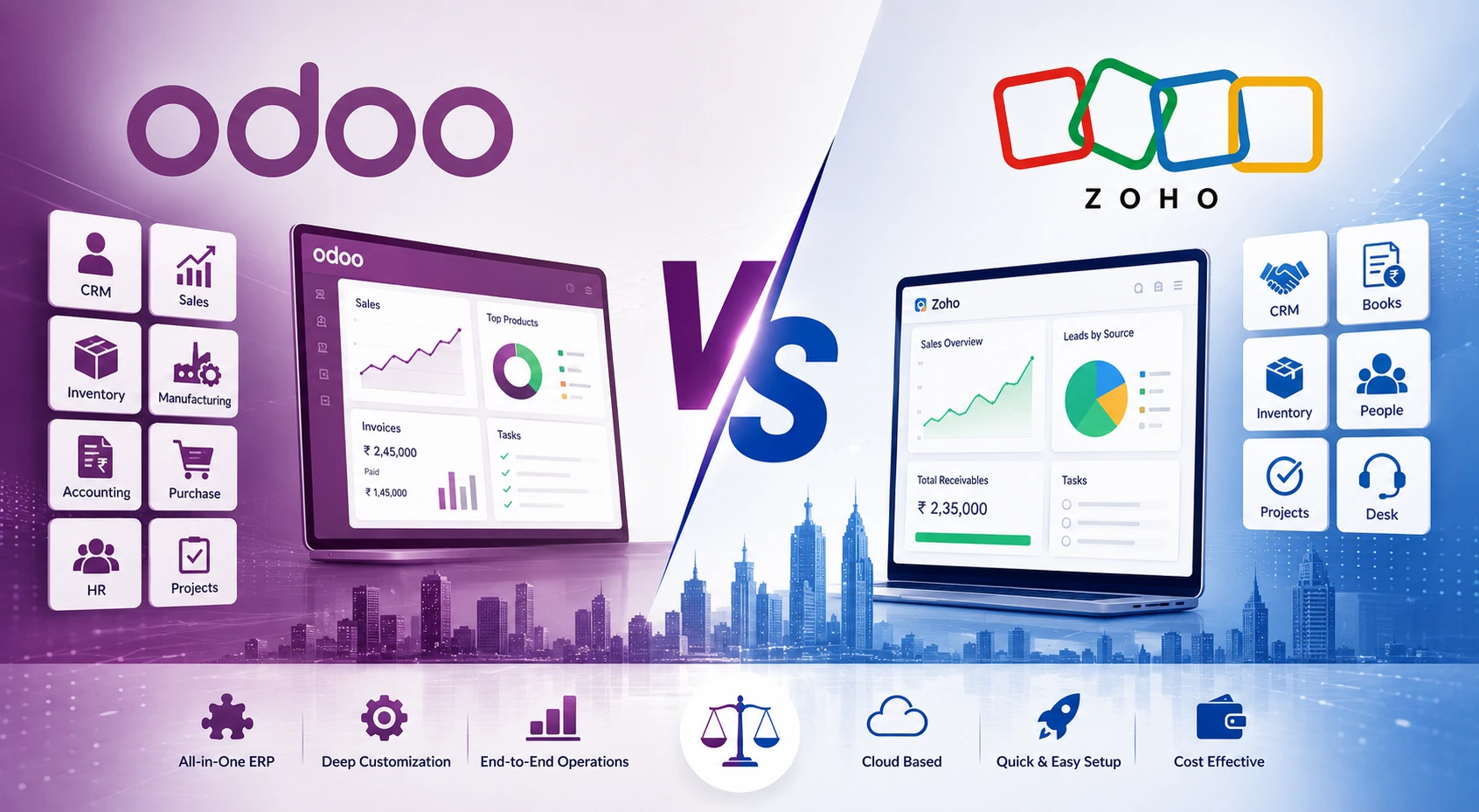
Indian businesses today are no longer choosing software just for accounting or CRM. They are choosing an operational backbone that can handle GST, inventory, payroll, sales, customer support, automation, eCommerce, and scalability.
Two names dominate this conversation: Odoo and Zoho.
Both platforms are powerful. Both are widely used in India. But they solve business problems very differently.
This comparison is not about “which is better globally.”
It is about which platform makes more sense for Indian SMEs, startups, manufacturers, traders, distributors, and service companies.
The Core Difference Between Odoo and Zoho
Before comparing features, it’s important to understand the philosophy behind both systems.
Odoo: ERP-First Approach
Odoo is fundamentally an ERP platform.
It is designed to connect operations across departments:
- Sales
- CRM
- Inventory
- Manufacturing
- Accounting
- HR
- Purchase
- Projects
- eCommerce
Everything runs on a unified database and workflow system. This becomes valuable when a business grows beyond simple bookkeeping or CRM needs.
Zoho: SaaS Ecosystem Approach
Zoho started as a cloud productivity and CRM company.
Instead of one deeply unified ERP, Zoho offers a large ecosystem of apps, such as:
- Zoho CRM
- Zoho Books
- Zoho Inventory
- Zoho People
- Zoho Desk
- Zoho Projects
For many Indian SMEs, this creates a fast, affordable, cloud-first setup.
Odoo vs Zoho: Feature-by-Feature Comparison
|
Feature
|
Odoo
|
Zoho
|
|---|---|---|
|
Best For
|
Operationally complex businesses
|
Fast-moving SMEs & startups
|
|
Deployment
|
Cloud, On-Premise, Hybrid
|
Primarily Cloud SaaS
|
|
Customization
|
Extremely high
|
Moderate
|
|
Ease of Setup
|
Medium to complex
|
Easy
|
|
Manufacturing Support
|
Strong native MRP
|
Limited
|
|
GST Compliance
|
Strong with localization
|
Excellent out of the box
|
|
CRM
|
Integrated ERP CRM
|
One of Zoho’s strongest products
|
|
Inventory Management
|
Advanced
|
Good for light-medium operations
|
|
Implementation Cost
|
Higher
|
Lower
|
|
Scalability
|
Very high
|
Good for SMB growth
|
|
Technical Dependency
|
Often needs implementation partner
|
Lower dependency
|
|
User Experience
|
Functional and modular
|
Cleaner for non-technical teams
|
Where Zoho Wins for Indian Businesses
1. Faster Deployment
Zoho is usually much quicker to implement.
Many Indian startups can start using:
- Zoho Books
- Zoho CRM
- Zoho Inventory
within days instead of months.
That matters when:
- teams are small,
- processes are evolving,
- and budgets are tight.
2. Better for Service Businesses
If your company mainly handles:
- consulting,
- agencies,
- SaaS,
- education,
- professional services,
- small trading,
Zoho often feels simpler and more practical.
You get:
- GST-ready invoicing,
- workflow automation,
- customer management,
- cloud accessibility,
without needing ERP consultants.
3. Excellent India Localization
Zoho’s India-specific ecosystem is one of its strongest advantages.
It handles:
- GST invoicing,
- e-invoicing,
- banking integrations,
- payroll localization,
- Indian tax workflows
very well.
Since Zoho is India-focused, Indian SMEs often find support, onboarding, and documentation more aligned with local business realities.
4. Lower Initial Costs
For smaller teams, Zoho usually has lower upfront costs.
Businesses with:
- 5–20 users,
- basic inventory,
- standard accounting,
- light CRM usage
often find Zoho more affordable initially.
Where Odoo Wins for Indian Businesses
1. Stronger ERP Capabilities
Odoo becomes significantly more powerful when business operations become complex.
This includes:
- manufacturing,
- multi-warehouse inventory,
- procurement workflows,
- vendor management,
- production planning,
- repair/service operations,
- B2B distribution.
Unlike app-based workflows, Odoo connects these operations inside a unified ERP architecture.
2. Better for Manufacturing Companies
This is one of the biggest differentiators.
Odoo includes native:
- MRP,
- BOM management,
- work orders,
- quality checks,
- shop floor operations,
- subcontracting workflows.
Zoho’s ecosystem is generally considered weaker for advanced manufacturing workflows.
If your business runs factories, assembly units, or large inventory operations, Odoo often becomes the more scalable long-term choice.
3. Higher Customization Flexibility
Odoo is open-source at its core.
That means businesses can heavily customize:
- workflows,
- dashboards,
- approvals,
- modules,
- automation,
- integrations.
This flexibility is valuable for companies whose operations do not fit “standard SaaS workflows.”
But there is a tradeoff:
greater flexibility often means greater implementation complexity.
4. Better Long-Term Operational Control
Many businesses outgrow disconnected tools.
As operations become more complicated, companies often struggle with:
- sync issues,
- duplicate data,
- fragmented reporting,
- multiple subscriptions,
- disconnected inventory/accounting systems.
Odoo’s unified architecture helps solve this problem.
The Hidden Reality: Cost Is Not Just Subscription Pricing
This is where many Indian businesses make mistakes.
Zoho’s Hidden Cost Pattern
Zoho appears cheaper initially.
But costs rise when businesses start adding:
- CRM,
- Inventory,
- Analytics,
- Payroll,
- Automation,
- Helpdesk,
- advanced workflows.
Over time, businesses may end up managing multiple subscriptions and integrations.
Odoo’s Hidden Cost Pattern
Odoo’s subscription cost is often not the biggest expense.
The higher cost usually comes from:
- implementation,
- customization,
- consulting,
- migration,
- training,
- support.
If implementation is poorly handled, projects can become expensive and slow.
That’s why choosing the right implementation partner matters more in Odoo than in Zoho.
What Indian Businesses Usually Choose
Choose Zoho If:
You are:
- a startup,
- service business,
- small SME,
- agency,
- consulting firm,
- or early-stage trading company.
And you want:
- quick deployment,
- low technical dependency,
- affordable SaaS,
- easy onboarding,
- strong CRM and finance tools.
Choose Odoo If:
You are:
- a manufacturer,
- distributor,
- retailer,
- multi-location business,
- warehouse-heavy company,
- or a rapidly scaling enterprise.
And you need:
- deep ERP control,
- advanced inventory,
- manufacturing workflows,
- centralized operations,
- heavy customization,
- long-term scalability.
The Most Realistic Verdict
There is no universal winner between Odoo and Zoho.
The better platform depends on business complexity.
Zoho is better for:
- simplicity,
- speed,
- affordability,
- cloud-first operations,
- non-technical teams.
Odoo is better for:
- operational depth,
- ERP centralization,
- manufacturing,
- customization,
- scalability.
For many Indian businesses, the real decision is not:
“Which software is better?”
The real question is:
“How complex will our business become in the next 3–5 years?”
That answer usually determines whether Zoho remains sufficient—or whether Odoo becomes necessary.
Final Thoughts
Indian businesses are evolving quickly.
Companies that once managed operations on Excel, Tally, and WhatsApp now require:
- automation,
- real-time reporting,
- integrated operations,
- GST-ready systems,
- scalable infrastructure.
Both Odoo and Zoho can help businesses modernize.
But success depends less on software branding and more on:
- implementation quality,
- process clarity,
- leadership adoption,
- and long-term planning.
Choosing the right platform today can save years of operational pain later.

Swati Rawat is a writer and researcher with a strong interest in digital transformation, emerging technologies, and the evolving intersection of business and innovation. At DX8, she focuses on translating complex ideas into clear, actionable insights, helping readers understand how technology shapes modern organizations and decision-making. With a detail-oriented approach and a passion for continuous learning, Swati contributes thoughtful, well-researched content designed to inform, engage, and empower a global audience.